


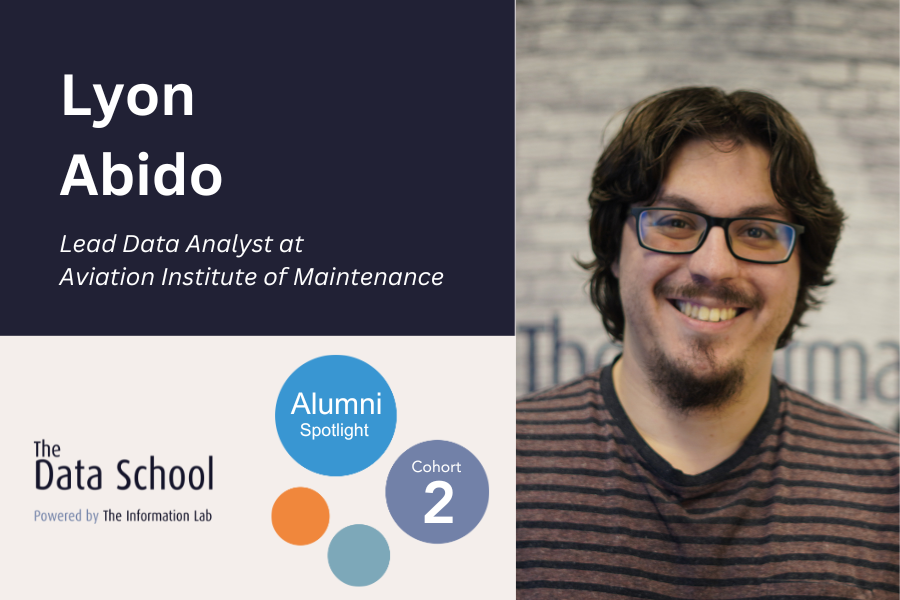
Learn how an online teacher hacked his way into data. Find out how online classrooms, Discord chats, and late-night coding sessions led Lyon to an unexpected journey. Now leading analytics at the Aviation Institute of Maintenance (AIM). He’s using data to shape student success in ways he never imagined, before his time at The Data School New York (DSNY2).
Interviewed by Alisha Javed | Edited by Collin Smith and Lyon Abido
Before The Data School
Before joining The Data School, Lyon worked as an online English teacher for nearly two years. It was during this time that he began learning Python alongside his father, who was transitioning into a more technical engineering role. Together, they explored topics like data cleaning and visualization with tools like Pandas, NumPy, and Matplotlib.
Although Lyon studied political science and government in university, he was already intrigued by the world of data. “My exposure was entirely unconventional,” Lyon shared. “I didn’t learn Tableau, Alteryx, or stakeholder management in school, but learning Python with my dad lit the spark.”
Lyon found out about The Data School through an unconventional route; Discord. “Someone from DSNY1 had shared a link to a meet-and-greet session. I joined out of curiosity, spoke to a few people from the UK team, and immediately fell in love with the mission”. Shortly after, he submitted his dashboard application and was accepted into DSNY2.
Interestingly, this wasn’t the only time Discord helped Lyon land a data role. His current job at AIM also came from a post he found in a data-related Discord channel. “Discord has been two-for-two for me in terms of job opportunities,” he said. “It’s unconventional”, but it seems like the unconventional places are where passionate learners gather.
During The Data School
Lyon’s training at The Data School was his first exposure to tools like Tableau and Alteryx, which he was prepared to learn. Yet an aspect he didn’t expect was the emphasis on stakeholder communication and consulting skills.
“One of the biggest mindset shifts was learning how to work with stakeholders—technical and non-technical alike,” Lyon reflected. “Coming from teaching, I had experience building informal relationships with students. But in consulting, you need to understand business goals, communicate clearly, and document everything.”
His three biggest takeaways?
- Data Cleaning – "Understanding where data comes from, how it’s structured, and how to prepare it effectively."
- Documentation – "Not just for developers, but for stakeholders. It’s about preserving context and making information accessible."
- Stakeholder Management – "Being able to speak the language of whoever’s in the room, whether it’s legal, HR, or C-Suite; and help them understand what data can do for them."
Lyon credits the Data School for helping him learn to “code switch” across departments and align his work with business objectives. “It’s not just about making dashboards. It’s about making dashboards that matter.”
After The Data School
Lyon now works as the Lead Data Analyst at the Aviation Institute of Maintenance, where he supports Cotulla Education’s mission to provide world-class vocational training. Although he’s only been in the role a few months, he’s already using his Data School lessons daily.
“I spend a lot of time learning the business, how it works, what programs we offer, and who our students are. That’s where communication and documentation come in,” Lyon explained. His goal, translate business needs into clear, actionable data insights using Tableau.
While the organization side of things has a dedicated data engineer to handle backend processes, Lyon still engages with SQL and data validation. But his primary focus is on front end analytics by designing dashboards that help educators and administrators make informed decisions.
Advice for Future Data Schoolers
“The biggest thing? Let go of the idea that you have to know everything.”
Lyon encourages new consultants to avoid the trap of imposter syndrome and the illusion of perfection often seen on social media. “So many people worry about not being a ‘unicorn’ who knows every tool. But that’s not the goal. Focus on skills like business thinking, stakeholder communication, and storytelling with data.”
He also urges aspiring analysts to think beyond tools: “Dashboards and code are only part of the job. To grow in this industry, you need to understand how data serves the business, and how you can be a partner in that journey.”