


As organizations become increasingly data-driven, they need somewhere to store all that information. Databases, data warehouses, and data lakes are commonly used for this purpose, but they don't all manage data the same way.
In data lakes, information can be spread across thousands of files. As the amount of data grows, so do the challenges of maintaining consistency, updating data structures, and keeping queries efficient. Managing these files as reliable, continuously changing tables requires more than just file storage.
For example, an organization may know its data is stored in Parquet files, but that doesn't automatically tell them which files make up the latest version of a table, how to safely update records, or what the table looked like before changes were made.
This is where Open Table Formats (OTFs) come in.
CSV vs. Parquet
Two common file formats used to store data are CSV and Parquet.
CSV files store data row by row, while Parquet uses column-based storage. This makes Parquet more efficient for analytical queries because systems can read only the columns they need instead of scanning every column in a dataset.
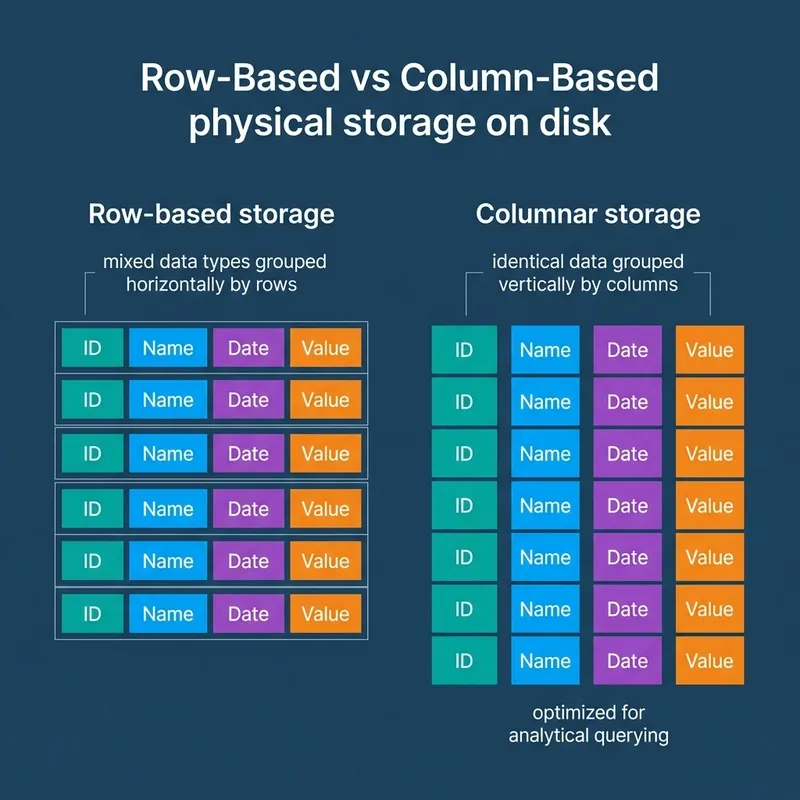
https://dev.to/alexmercedcoder/what-is-apache-parquet-columns-encoding-and-performance-333i
However, while Parquet improves how data is stored and read, it doesn't provide the tools needed to manage collections of files as reliable tables.
What Is an Open Table Format?
An Open Table Format (OTF) is a way of organizing and managing data files in a data lake so they can be treated more like database tables.
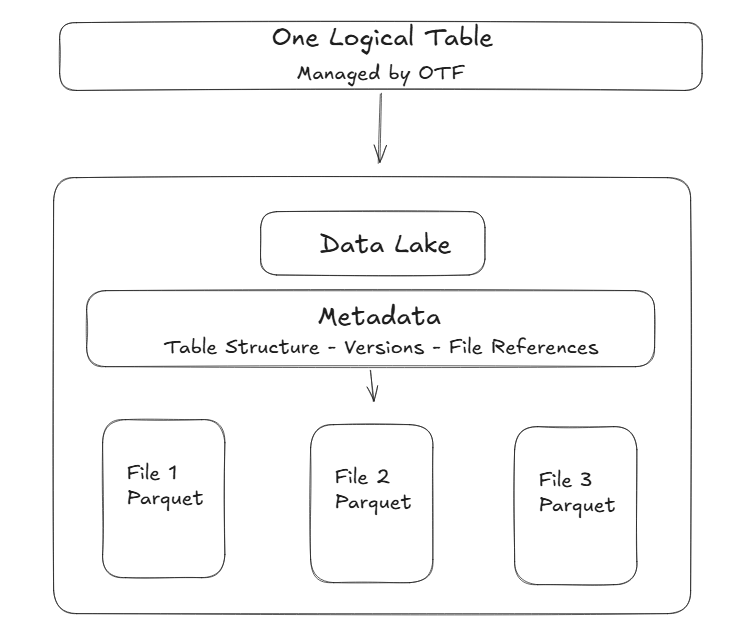
OTFs use metadata, or information about the data, to keep track of which files belong to a table, how the table is structured, and how it changes over time.
This makes several important capabilities possible:
- Atomic Commits: Ensure that changes are either fully committed or not committed at all, preventing partially completed transactions from becoming visible.
- Row-Level Updates and Deletes: Allow individual records to be modified or removed without having to manually rebuild an entire table.
- Schema Evolution: Allows changes to a table's structure, such as adding or removing columns, without having to recreate the entire dataset.
- Time Travel: Allows users to look back at previous versions of a table using retained snapshots.
- Concurrent Writers: Allow multiple processes to write to the same table while coordinating changes and detecting conflicts to prevent accidental overwrites.
Some examples of OTFs include Apache Iceberg, Delta Lake, and Apache Hudi.
Ultimately, Open Table Formats help organizations manage and analyze growing datasets more reliably and efficiently.