


Why is Git important?
In Data Engineering, version control serves as a 'backup' for code, facilitates collaboration and logs every code change. Git is a useful tool for version control. Rather than duplicating/replacing endless versions, it creates a snapshot of files at a moment in tie and stores references to that snapshot.
Git tracks and stores the history of your files (in any coding language) and serves as a backup.
Where you work:
To create a workflow, you will work between the remote GitHub and the local GitHub Desktop, editing in VS Code.
Steps of an example workflow:
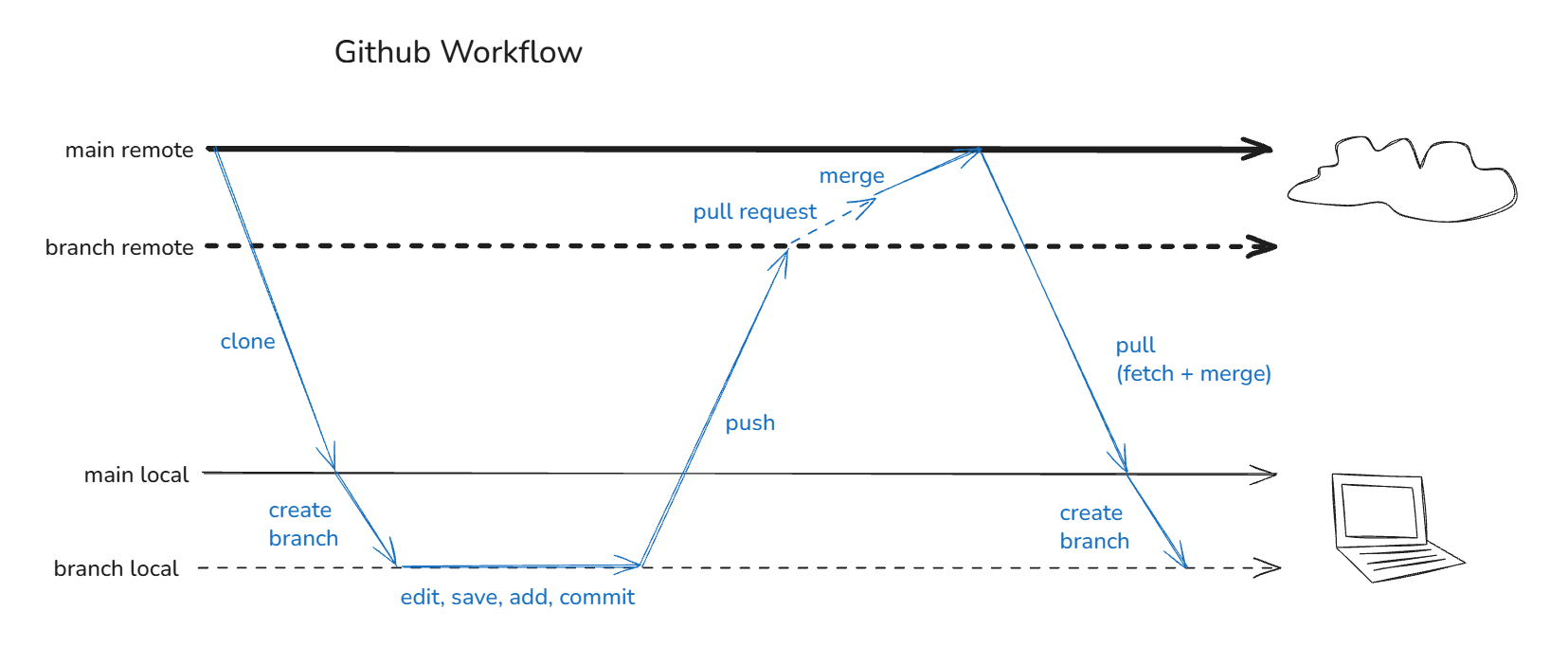
A GitHub workflow will have a main branch. When making any edits, you will work on additional branches, created primarily to develop code, before merging back with the main branch.
The diagram above shows an example workflow. The different steps can be described as followed:
- clone: bringing the remote code down to local before branching
- create branch: creating the branch where any edits will be made
- commit: these are the snapshots/checkpoints to feed back to GitHub
- push: this pushes the updates to remote (still in the development branch)
- pull/merge request: this is needed before a merge, as they will always need to be reviewed
- merge: once the pull request is approved, the updates will merge with the main branch
- fetch: checks if anything has changed on the remote version of a branch
- pull: fetches and merges any updates from remote into local